BOM
BOM
 My Request
TO-252 (DPAK) Power MOSFET Cross-Reference: RDS(on), Thermal Dissipation, and Drop-in Alternatives
Contents
- Why VDS and ID Are Not Enough
- What Should Be Checked in a TO-252 MOSFET Cross Reference?
- Why Gate Charge Can Break an Otherwise Good Replacement
- TO-252 Thermal Dissipation Depends on the PCB
- Can a Lower RDS(on) MOSFET Reduce BOM Cost?
- What About IRFR1205, STD12NF10, and AOD4184A?
- A Better Second-Sourcing Method
- Does a TO-252 Replacement Always Need a PCB Change?
- My View on DPAK MOSFET Cross-Reference
- Need Help Finding a TO-252 MOSFET Replacement?
TO-252, also known as DPAK, is one of those power MOSFET packages that can look simple from a purchasing perspective.
The package is familiar. The voltage rating is easy to compare. The current rating is usually printed clearly in the datasheet.
But those numbers are not enough to approve a replacement.
A MOSFET with the same TO-252 package and similar voltage and current ratings can behave very differently in the actual circuit.RDS(on), gate charge, gate-drive voltage and thermal pathcan all change the result.
This matters especially in power supplies, motor controllers, battery management systems and other designs where the MOSFET may operate continuously at high current.
Why VDS and ID Are Not Enough
Suppose an original MOSFET has an RDS(on) of 0.05 Ω and the proposed replacement is 0.08 Ω.
At the same drain current, conduction loss is calculated as:
P = I² × RDS(on)
At 10 A, the original device produces:
10² × 0.05 = 5 W
The replacement produces:
10² × 0.08 = 8 W
That is a60% increase in conduction loss.
So is the 0.08 Ω MOSFET automatically a bad replacement?
Not necessarily.
It depends on the actual current, switching conditions, PCB copper area and thermal design. But the example shows why matching only VDS and ID can hide an important difference.
This is also why a lower RDS(on) number should not be viewed in isolation. The value needs to be compared at thesame VGS and test current.
What Should Be Checked in a TO-252 MOSFET Cross Reference?
For a practicalTO-252 MOSFET cross reference, I would start with six parameters:
· VDS
· RDS(on)
· ID
· VGS
· Qg
· Thermal resistance
VDS needs enough margin for the normal rail voltage and transient conditions.
ID should be evaluated using the actual operating environment rather than the headline maximum rating.
RDS(on) should be compared at the gate voltage the circuit really provides.
This last point is particularly important for older power designs. A MOSFET that achieves a very low resistance at 10 V may not deliver the same result with a lower gate-drive voltage.
Why Gate Charge Can Break an Otherwise Good Replacement
RDS(on) mainly affects conduction loss.Gate charge Qgbecomes more important when the MOSFET is switching frequently.
A replacement with much higher Qg may place a greater demand on the gate driver. That can increase charging and discharging time and may increase switching loss.
So what happens if the replacement has a lower RDS(on), but much higher Qg?
My answer is: it depends on the switching frequency and driver capability.
For a slow load-switching application, the difference may be insignificant. For a DC-DC converter or motor-control circuit operating at high frequency, it can matter much more.
A real replacement therefore has to balance both conduction and switching performance.
The AOD4184A is a useful example of why the exact test conditions matter. AOS lists a maximum RDS(on) of 7 mΩ at 10 V and 20 A, 9.5 mΩ at 4.5 V, and total gate charge of 33 nC at 10 V. Its TO-252 package is rated for a junction temperature up to 175°C.
TO-252 Thermal Dissipation Depends on the PCB
Another common mistake is treating DPAK thermal performance as a package-only specification.
It is not.
The MOSFET generates heat at the die. That heat travels through the package and into the PCB copper before eventually reaching the surrounding environment.
This makes the PCB part of the thermal system.
Infineon's IRFR1205, for example, is a 55 V DPAK MOSFET with a published RDS(on) maximum of 27 mΩ at 10 V, typical Qg of 43.3 nC at 10 V, and a maximum junction-to-case thermal resistance of 1.8 K/W.
These figures are useful for comparison, but they should not be interpreted as a guarantee of a particular junction temperature on every PCB.
Copper area, board thickness, layer structure, ambient temperature and airflow all affect the final result.
That is whyTO-252 MOSFET thermal dissipationshould be evaluated at board level.
Can a Lower RDS(on) MOSFET Reduce BOM Cost?
Sometimes the answer is surprisingly yes.
A MOSFET with a slightly higher unit price may reduce conduction loss enough to simplify thermal management. It may also reduce the copper area or cooling requirements in some applications.
The opposite can also happen.
A cheaper replacement with higher RDS(on) may create more heat and require engineering changes elsewhere.
This is why I prefer comparingtotal design costrather than only the unit price.
For a BMS board, motor controller or power converter, I would compare:
· MOSFET price
· RDS(on) at actual VGS
· Qg
· PCB copper requirement
· Thermal margin
· Driver compatibility
· Availability
· Qualification effort
What About IRFR1205, STD12NF10, and AOD4184A?
These parts should not be treated as interchangeable simply because they use the TO-252/DPAK family.
IRFR1205 is a 55 V DPAK device from Infineon, while AOD4184A is a 40 V TO-252 device from Alpha & Omega. Their electrical characteristics are different, including RDS(on), Qg and current ratings.
ForIRFR1205 equivalentsourcing, I would start by protecting the original voltage margin and then compare RDS(on) and gate charge at comparable test conditions.
For anSTD12NF10 drop-in alternative, the exact ST part number, package drawing and datasheet revision should be confirmed before calling another DPAK MOSFET a drop-in replacement. A similar family name or package is not enough evidence.
This is particularly important with older MOSFETs, where different manufacturers may use very different electrical targets within the same package family.
A Better Second-Sourcing Method
For procurement teams, I recommend building the replacement list around the original application instead of the part number alone.
First, confirm the exact MPN and package.
Then record:
VDS → RDS(on) → VGS → Qg → thermal conditions → pinout
After that, evaluate whether the candidate can be tested on the existing PCB.
This creates a much more usefulDPAK MOSFET replacementlist than a catalog search based only on voltage and current.
The same method works forstd12nf10 equivalent power mosfet sourcingand for long-term second-source planning.
Does a TO-252 Replacement Always Need a PCB Change?
Not necessarily.
Many TO-252 devices use the same basic physical package, but that does not guarantee identical dimensions, lead arrangement or tab behavior.
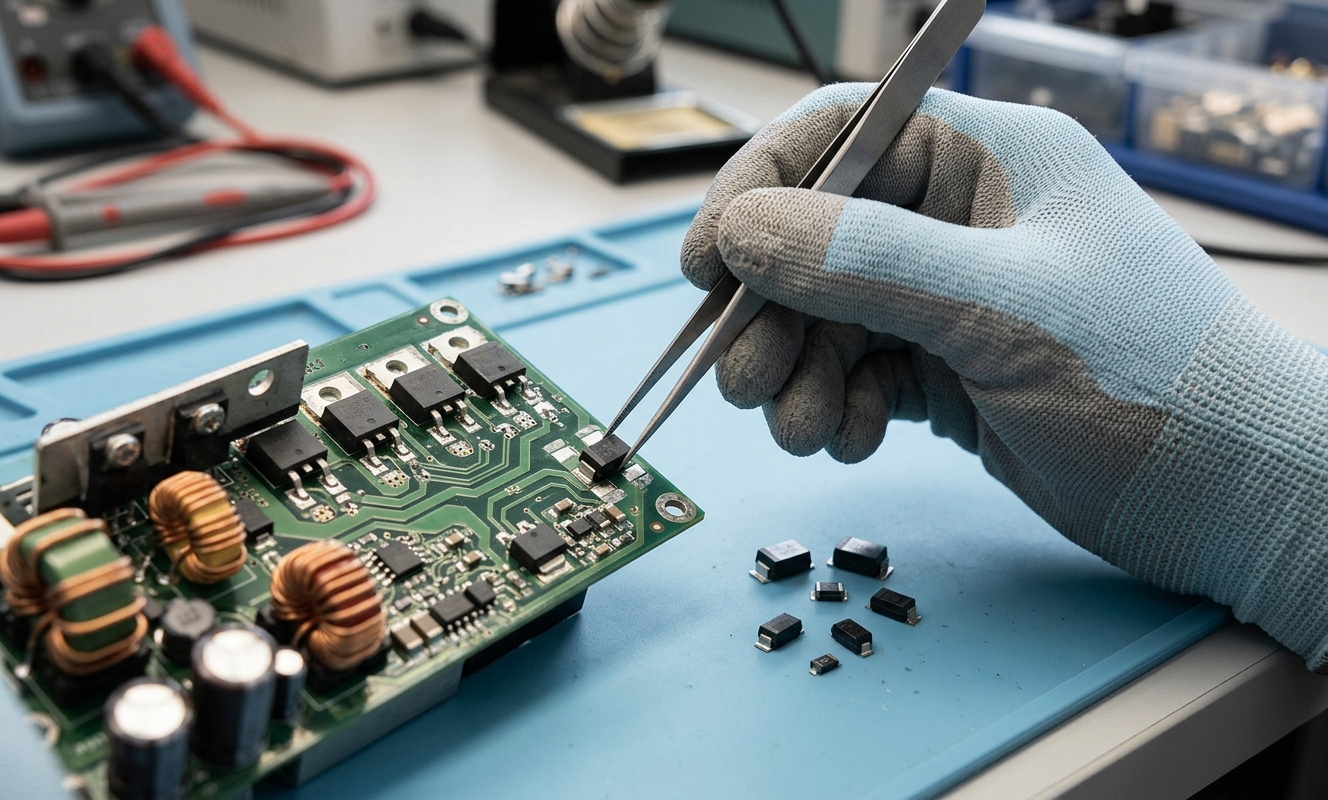
Before approving a claimed drop-in replacement, compare the mechanical drawing and PCB land pattern.
The tab is also electrically significant on many power MOSFETs because it is connected to the drain. That makes PCB copper placement important for both electrical and thermal reasons.
A replacement that fits the solder pads but changes the electrical connection of the exposed tab is not a safe substitution.
My View on DPAK MOSFET Cross-Reference
I would not choose a replacement by asking:
"Does it have the same VDS and ID?"
I would ask:
"Will it produce similar losses, accept the same gate drive, fit the same PCB, and remain thermally safe in the actual application?"
That is a much better definition of adrop-in alternative.
For high-current designs, the difference between 0.05 Ω and 0.08 Ω can be much more important than a small difference in unit price. At the same time, an extremely low RDS(on) device may not be the best choice if its Qg places too much stress on the gate driver.
The real goal is balance.
A goodbms board power mosfet cross reference guideshould therefore consider electrical performance, gate-drive behavior, package compatibility and thermal design together.
For sourcing teams, that approach also creates a better path to cost reduction and second sourcing without assuming that every TO-252 MOSFET is interchangeable.
The package may be standardized. The engineering requirements are not.
Looking for a replacement for AOD4184A, IRFR1205, STD12NF10, or another TO-252/DPAK MOSFET? Send us the exact MPN, target specifications, or BOM. We can help check RDS(on), gate charge, package compatibility, thermal requirements, and available sourcing options.
Need Help Finding a TO-252 MOSFET Replacement?