BOM
BOM
 My Request
Pin-to-Pin Replacement: What “Drop-In” Really Means
Contents
- Same Package Does Not Mean Same Replacement
- What Does “Pin-to-Pin” Actually Mean?
- Electrical Parameters Need to Match the Application
- Thermal and Parasitic Equivalence Are Easy to Miss
- Can a Pin-to-Pin Replacement Really Avoid PCB Redesign?
- How to Build a Useful Component Cross Reference Guide
- BOM Second Source Sourcing: Where the Real Value Is
- What Should Procurement Ask Before Ordering?
- My View on Drop-In Alternatives
- Looking for a Qualified Component Alternative?
When an electronic component becomes expensive, difficult to source, or reaches the end of its production life, the first question from purchasing is often simple:
"What is the replacement?"
The engineering answer is usually more complicated.
A replacement may have the same package, the same number of pins, and even a similar datasheet specification. That does not automatically make it a drop-in replacement.
In practice, I look at three areas first:
Does it fit the PCB?
Does the pinout match?
Does it behave correctly under the actual operating conditions?
Only when those questions are answered can a supplier reasonably describe a part as a potentialpin to pin replacement electronic component.
TI itself separates cross-reference results into categories such as "drop-in replacement," "pin-for-pin replacement," "same functionality," and "similar functionality." That distinction is useful because it shows that "equivalent" is not one universal technical term.
Same Package Does Not Mean Same Replacement
This is probably the most common mistake in component sourcing.
Two ICs may both use SOIC-8. Two MOSFETs may both use SOT-23. Two diodes may both use SMA.
But the package name only describes the physical package family. It does not guarantee the same pin assignment.
Before approving an alternative, I compare:
· Pin number and pin function
· Package dimensions
· PCB land pattern
· Exposed pad or thermal tab
· Electrical polarity and internal connections
This is especially important for parts such as dual diodes, MOSFETs, optocouplers, and interface ICs, where a different internal connection can make an apparently identical package unusable.
What Does "Pin-to-Pin" Actually Mean?
Apin compatible replacement ICnormally means that the replacement can use the same PCB pin connections without requiring a board redesign.
But that is only the hardware side.
A true drop-in alternative also needs suitable electrical behavior.
For example, replacing a MOSFET requires more than matching VDS and ID. RDS(on), gate-drive voltage, gate charge and thermal performance can change the result.
For a diode, forward voltage, reverse recovery, leakage and capacitance may matter.
For an optocoupler, CTR and isolation characteristics can be much more important than the fact that both devices have four pins.
This is why I prefer the termqualified alternativeover simply "equivalent."
Electrical Parameters Need to Match the Application
The next step is to compare the parameters that actually control circuit behavior.
A useful review usually includes:
Voltage → Current → Timing → Losses → Thermal behavior
The exact parameters depend on the component.
For a MOSFET, RDS(on) at the actual gate voltage is important. For a switching diode, tRR may matter more than a small difference in forward voltage. For an LDO, dropout voltage, current limit and thermal behavior should be checked.
The key question is:
Which parameter is actually limiting the original design?
A replacement with better headline specifications may still be worse in the real circuit.
For example, a lower RDS(on) MOSFET may have substantially higher gate charge. That could increase switching losses in a high-frequency converter even though the datasheet looks better at first glance.
This is why adrop in alternative semiconductorshould be compared under comparable test conditions rather than by copying the biggest or smallest number from each datasheet.
Thermal and Parasitic Equivalence Are Easy to Miss
Electrical compatibility is not always enough.
A replacement may fit the footprint and pass the initial bench test but operate at a higher temperature because of different losses or package thermal characteristics.
The same problem can appear with parasitic capacitance, inductance, switching speed, or leakage current.
These differences may be unimportant in a low-speed control circuit and critical in a high-frequency power supply.
So I ask another question during qualification:
Will the replacement see the same electrical and thermal environment as the original part?
If the answer is uncertain, the substitute needs testing before the BOM is changed.
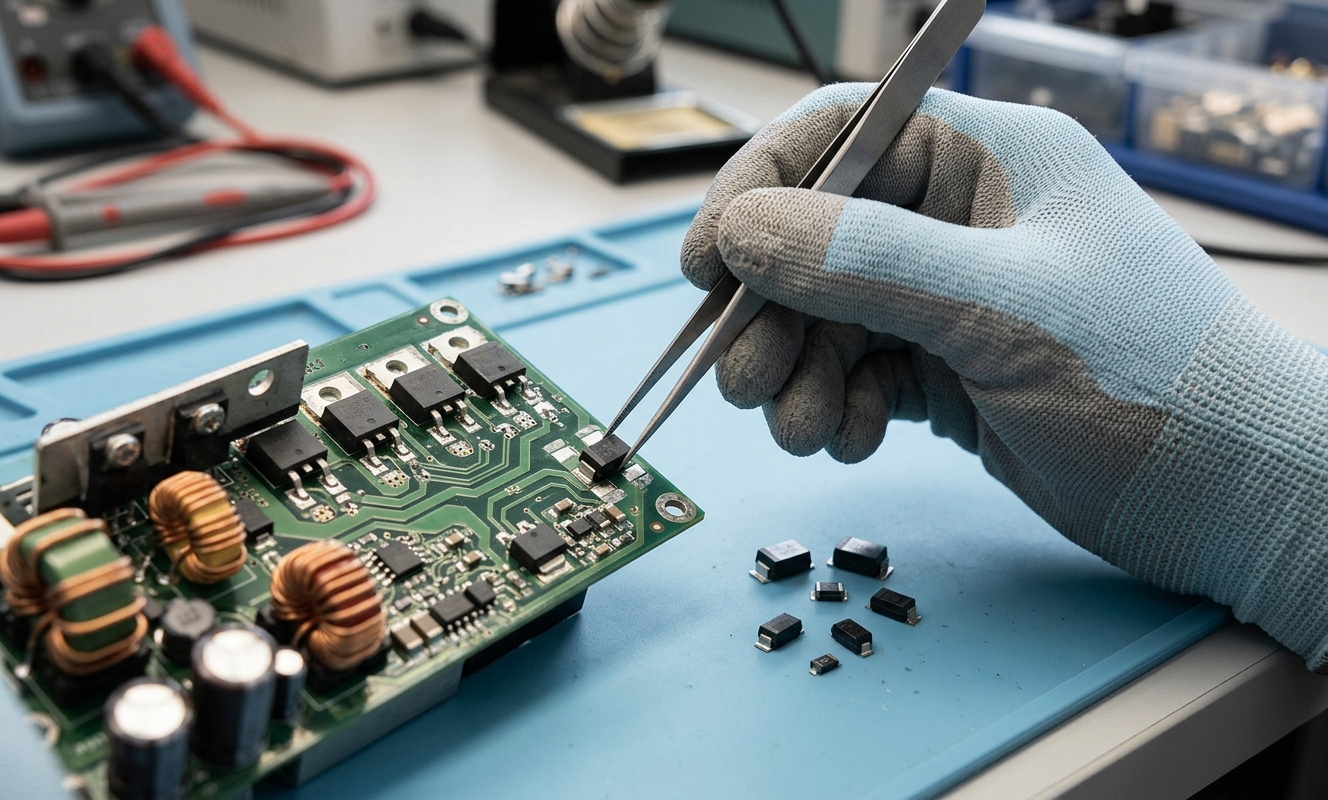
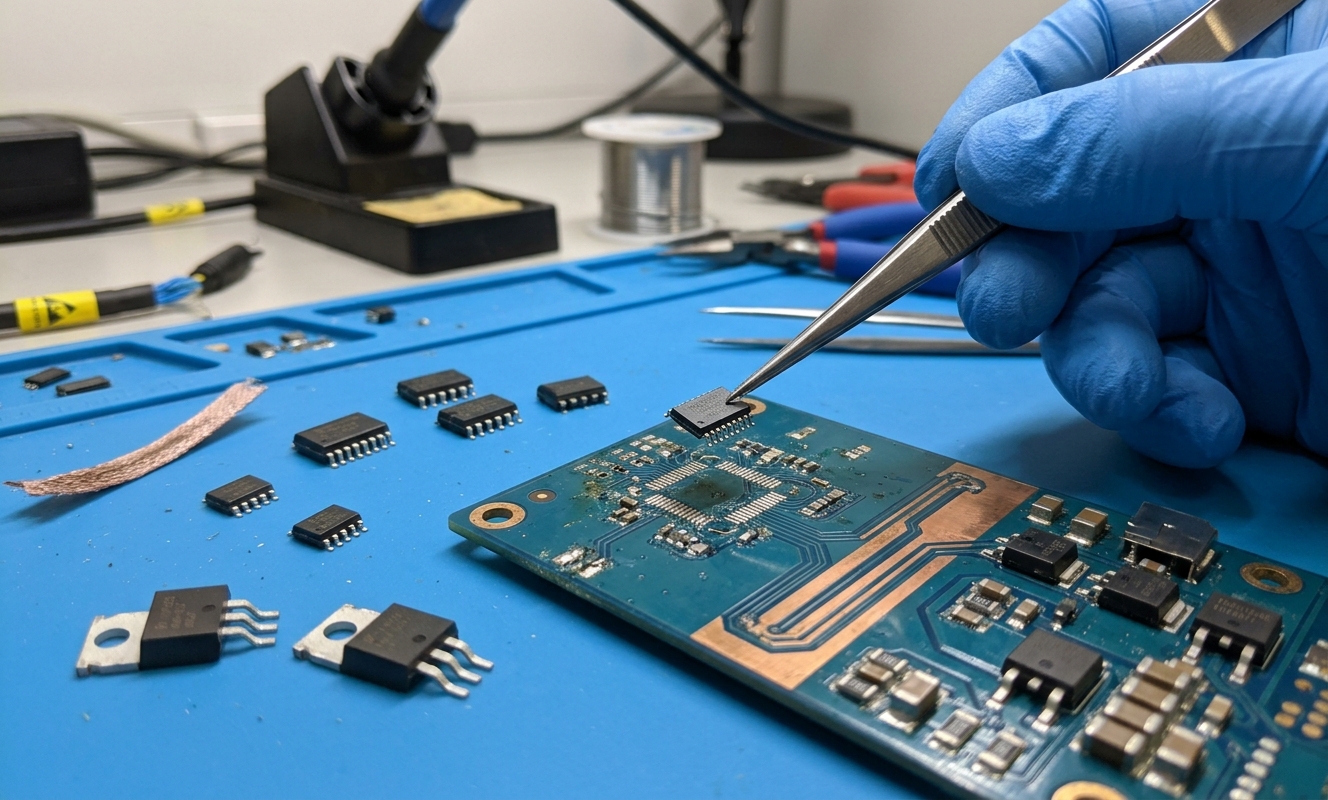
Can a Pin-to-Pin Replacement Really Avoid PCB Redesign?
Sometimes yes. But I would not promise "zero PCB modification" simply because the package and pinout look identical.
The exact datasheets and mechanical drawings still need to be checked.
There are cases where manufacturers themselves explicitly identify a replacement as having the same form, fit and function and being pin-for-pin equivalent. For example, NXP has published device-migration notices identifying certain replacements as "Same Form, Fit & Function, Pin-for-Pin Equivalent."
But NXP also publishes discontinuation notices where replacement devices are functionally similar yetnot package- and pinout-compatible.
That is the distinction procurement teams need to understand.
Functionally equivalent does not necessarily mean drop-in.
How to Build a Useful Component Cross Reference Guide
For a practicalcomponent cross reference guide, I recommend using a simple qualification table:
|
Check |
What to Compare |
|
MPN |
Complete manufacturer part number and suffix |
|
Package |
Exact package and dimensions |
|
Pinout |
Pin functions and internal topology |
|
Electrical |
Voltage, current, timing, leakage, etc. |
|
Thermal |
Power dissipation and thermal resistance |
|
Mechanical |
Footprint, pad and mounting conditions |
|
Compliance |
Qualification and applicable certifications |
|
Supply |
Stock, lead time, manufacturer and second source |
This is also why cross-reference tools should be treated as a starting point, not final approval. NXP's own cross-reference tool states that suggested matches are provided for convenience and that the user remains responsible for selection, validation and testing.
BOM Second Source Sourcing: Where the Real Value Is
A second source becomes valuable when it reduces supply risk without creating a second engineering project.
For aBOM second source sourcingstrategy, I would normally identify alternatives before the original supplier becomes difficult to buy from.
The preferred candidate is not always the cheapest part.
I would rank alternatives by:
technical fit + PCB compatibility + qualification effort + availability + total cost
This is especially useful when dealing with long lead times or volatile spot-market pricing.
A replacement that can be tested on the existing board is often much more useful than one that looks cheaper but requires a redesign.
NXP provides a practical example of this type of cross-reference workflow through its competitor-part search, which returns potentially compatible NXP parts for a given competitor MPN.
What Should Procurement Ask Before Ordering?
Instead of asking only:
"Do you have a replacement?"
I recommend sending the supplier:
· Original MPN
· Manufacturer
· Package
· Required quantity
· Key electrical parameters
· PCB footprint requirement
· Pin-to-pin requirement
· Target application
· Sample requirement
A complete request allows the supplier to distinguish between a true drop-in alternative and a part that merely performs a similar function.
It also makes RFQ comparison much easier.
My View on Drop-In Alternatives
I do not think the goal should be to find a component that is "almost the same."
The goal is to find a replacement that introducesthe least engineering risk.
For an existing production board, a genuine pin-to-pin alternative can save significant time because it may avoid PCB changes. But the replacement still needs electrical and thermal validation before production approval.
For new designs, the strategy can be different. It may be better to deliberately qualify two manufacturers from the beginning instead of designing around a single source.
That is the more useful meaning of second sourcing.
A goodpin to pin replacement electronic componentsstrategy is therefore not just a search for a matching part number. It is a structured comparison ofform, fit, function, thermal behavior, qualification effort and supply continuity.
The package may match. The pinout may match. The price may even be lower.
But the real question is still the same:
Will the replacement work on the existing board, under the existing operating conditions, without creating a new sourcing or reliability problem?
Send us your MPN or BOM. We can help review pin-to-pin compatibility, electrical specifications, package options, and current sourcing availability.
Looking for a Qualified Component Alternative?