BOM
 My Request
MEMS Digital Humidity & Temperature Sensors vs. Traditional RTD/Thermistor Probes in HVAC & Cold Chain Logistics
Contents
- Key Takeaways
- The Measurement Problem Is Not Just the Sensor
- Digital Sensor IC vs. RTD vs. Thermistor
- Why Digital Sensors Are Attractive for Cold Chain Monitoring
- When Are RTD and Thermistor Probes Still the Better Choice?
- Chemical Contamination and Long-Term Humidity Accuracy
- Questions Engineers Should Ask
- Final Recommendation
Key Takeaways
Digital humidity and temperature sensor ICs simplify circuit design by integrating sensing and signal processing, with factory-calibrated readings available through a digital interface.
Pt100/Pt1000 RTDs and thermistors remain useful when remote probe placement, mechanical protection, or a specific temperature measurement range is required.
Factory calibration reduces component-level adjustment, but it does not eliminate system verification or periodic calibration requirements.
VOCs, solvents, and other chemical contaminants can affect humidity sensor performance. Material compatibility and installation conditions should be checked before selecting a sensor.
The Measurement Problem Is Not Just the Sensor
Consider a cold chain data logger installed inside a refrigerated storage cabinet. It records temperature and humidity throughout the day, then uploads the readings to a monitoring system.
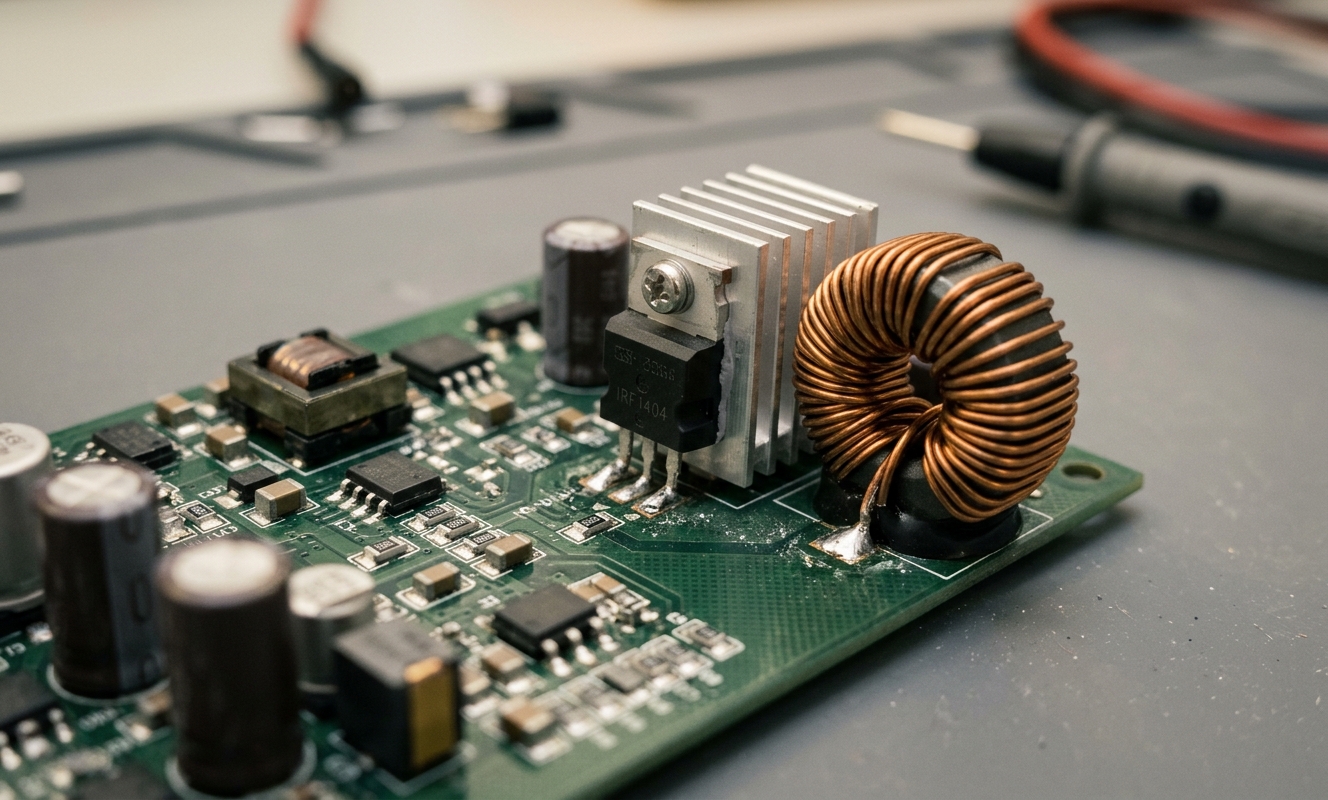
The measurement chain may look simple, but several things can go wrong. A temperature sensor mounted too close to a voltage regulator may read warmer than the surrounding air. A probe installed near an evaporator may respond to local cooling rather than the average storage condition. A humidity sensor exposed to cleaning solvents may gradually produce readings that no longer match its original calibration.
These problems are not solved simply by choosing a sensor with a better accuracy specification.
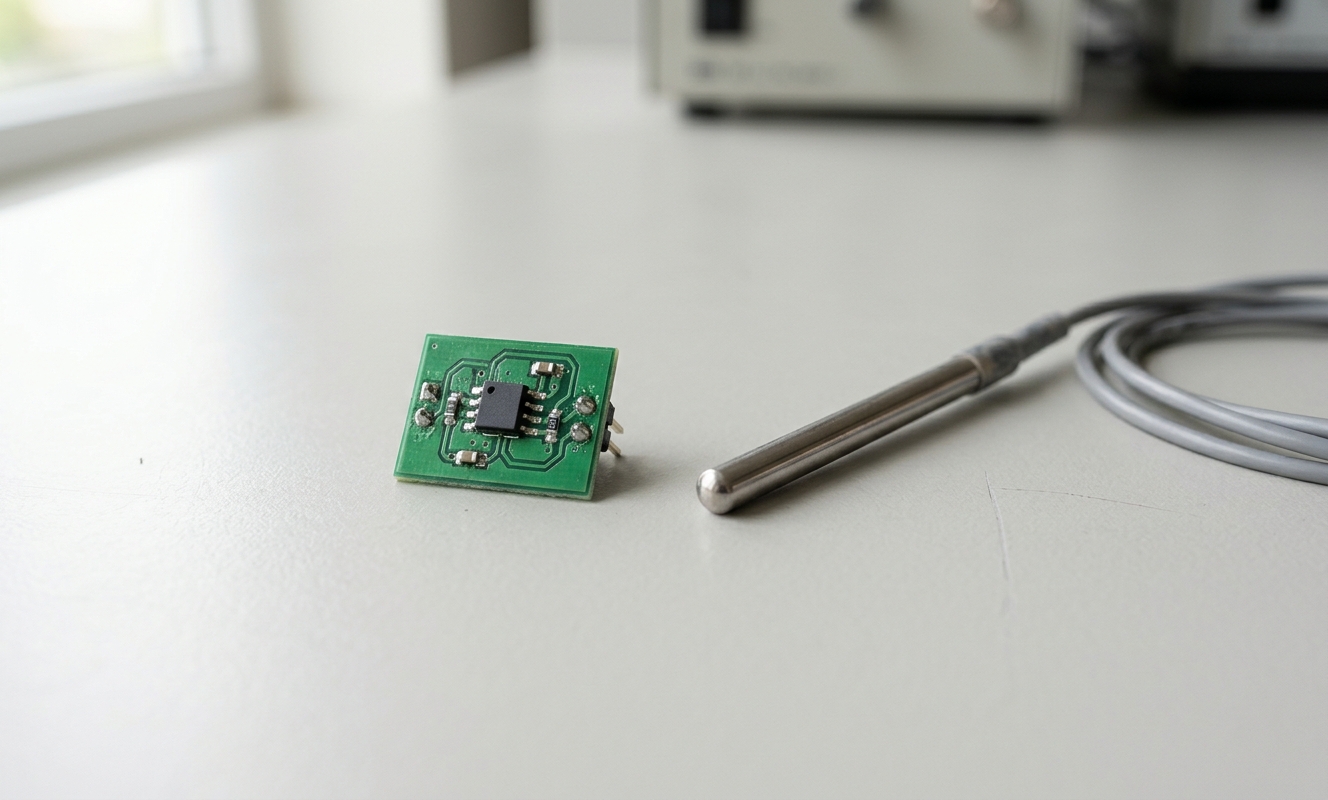
Traditional designs often use thermistors or Pt100/Pt1000 RTDs connected to analog measurement circuits. Digital environmental sensors take a different approach: they combine the sensing element with signal conditioning and conversion circuitry, allowing a microcontroller to read processed measurement data directly.
For compact HVAC controllers and cold chain monitoring devices, this integration can reduce design work. The important question is whether the sensor's physical characteristics and measurement performance fit the actual installation.
Digital Sensor IC vs. RTD vs. Thermistor
|
Parameter |
Digital Humidity & Temperature IC |
Pt100/Pt1000 RTD |
Thermistor |
|
Measurement |
Temperature and relative humidity |
Temperature |
Temperature |
|
Output |
Digital, commonly I²C |
Resistance |
Resistance |
|
External circuitry |
Power supply and digital interface |
Excitation and resistance-measurement circuit |
Resistance-measurement circuit |
|
Calibration |
Usually factory calibrated |
Depends on probe and measurement system |
Depends on component tolerance and measurement system |
|
Temperature response |
Depends on package and airflow |
Depends on probe construction and installation |
Depends on bead, package, and installation |
|
Remote measurement |
Usually requires a suitable sensor module or remote assembly |
Well suited to wired probe assemblies |
Available in wired probe assemblies |
|
Main advantage |
Compact integration and convenient digital output |
Established measurement method and flexible probe construction |
High sensitivity over a selected temperature range |
|
Main concern |
Contamination, self-heating, and mounting effects |
Wiring resistance and measurement accuracy |
Nonlinear response and component variation |
An RTD does not always need a Wheatstone bridge. A suitable precision ADC and excitation circuit can also measure its resistance. Likewise, a thermistor can be read through a relatively simple voltage divider. The required electronics depend on the accuracy target, wiring arrangement, and system design.
Why Digital Sensors Are Attractive for Cold Chain Monitoring
A digital humidity and temperature sensor can reduce the number of separate components required on a monitoring PCB. Instead of designing independent analog measurement paths for temperature and humidity, the engineer can use a combined sensor and read its output through a microcontroller interface.
Devices in the Sensirion SHT family are examples of this approach. Depending on the specific model, they provide calibrated temperature and relative humidity measurements through a digital interface, commonly I²C.
This is useful in compact data loggers, wireless monitoring nodes, and HVAC control boards where PCB space and assembly time matter.
There is also a firmware advantage. The microcontroller receives measurement values rather than raw resistance values that must first be converted using a thermistor curve or RTD equation.
However, factory calibration should not be confused with calibration of the complete monitoring system. If a logger is used for regulated cold chain applications, the assembled device may still need verification against a traceable reference. Sensor placement, enclosure design, airflow, and thermal coupling can all affect the final reading.
When Are RTD and Thermistor Probes Still the Better Choice?
A digital sensor mounted directly on a PCB measures the environment around that package. This can be a disadvantage when the measurement point is physically separated from the controller.
For example, a refrigeration unit may need to measure temperature inside a duct, near a storage compartment, or at a location that is difficult to reach with the main control PCB. A wired Pt100 or Pt1000 probe can be easier to install in these situations.
RTDs are also worth considering when the application requires a particular temperature range, probe construction, or established calibration procedure. Four-wire measurement can reduce the influence of lead resistance in demanding applications, although it increases wiring and connection complexity.
Thermistors are often practical for cost-sensitive temperature measurement over a defined operating range. Their resistance changes substantially with temperature, but the relationship is nonlinear. Firmware or a lookup table is normally needed to convert resistance into temperature accurately.
The choice should therefore be based on the measurement location and required performance, not simply on whether the sensor has a digital output.
Chemical Contamination and Long-Term Humidity Accuracy
Humidity sensors require particular attention in industrial environments.
Many capacitive humidity sensors use a moisture-sensitive polymer layer. Certain VOCs, solvents, cleaning agents, and other airborne chemicals can interact with this material. Depending on the chemical and exposure conditions, the result may be a temporary measurement shift or more persistent degradation.
This is relevant in HVAC systems exposed to cleaning products, industrial facilities with chemical vapors, and cold chain equipment containing adhesives, sealants, or plastic components that release volatile substances.
A protective membrane can help reduce exposure to particles and certain contaminants, but it should not be treated as universal chemical protection. Its effect on response time and humidity exchange also needs to be considered.
For low-drift environmental monitoring chips, engineers should review the manufacturer's contamination guidance, avoid exposing the sensing element to incompatible solvents during assembly, and test the sensor in the actual enclosure and operating environment.
Questions Engineers Should Ask
Question 1: Can a digital sensor replace a thermistor assembly directly?
Not automatically. A digital sensor normally uses a different electrical interface and requires firmware changes. The designer must also check the measurement range, accuracy, response time, package, power supply, and physical installation.
Question 2: Does factory calibration remove the need for system calibration?
No. It reduces the need for individual component adjustment, but the finished product may still require verification or periodic calibration. This is especially important when measurements are used for product storage records, quality control, or regulatory compliance.
Question 3: Which sensor is more suitable for industrial HVAC?
A digital humidity and temperature IC is convenient when both measurements are needed close to the controller. A wired RTD or thermistor probe may be more suitable when the measurement point is remote or requires a specific mechanical assembly.
Question 4: What should be checked when selecting an SHT series replacement?
Compare the complete part number, temperature and humidity accuracy, operating range, supply voltage, communication interface, package dimensions, response time, and contamination resistance. Also check whether the replacement has the same pinout and firmware requirements. Similar sensor specifications do not guarantee drop-in compatibility.
Final Recommendation
For compact HVAC controllers and cold chain data loggers, digital humidity and temperature sensor ICs can make the electronics simpler and reduce the work involved in analog measurement design. They are particularly useful when both environmental measurements are needed on a small PCB.
RTD and thermistor probes still have a clear role in remote measurement, specialized probe assemblies, and applications with established calibration requirements.
Before choosing a sensor, consider where it will be installed, what it will be exposed to, and how the finished equipment will be calibrated. A factory-calibrated IC can save circuit-design effort, but it cannot compensate for poor placement, an unsuitable enclosure, or chemical contamination.
For component sourcing and second-source evaluation, compare the complete orderable part number and datasheet specifications. Check the interface, package, accuracy, response time, operating range, and lifecycle status before approving an SHT series sensor replacement in industrial HVAC equipment.