BOM
BOM
 My Request
SN74HC595D vs 74HC595PW vs MC74HC595ADR2G: Shift Register IC Comparison
Contents
- Why the Same 74HC595 Part Number Family May Require Different Considerations
- What Does a 74HC595 Shift Register Do?
- Are SN74HC595D, 74HC595PW, and MC74HC595ADR2G Direct Replacements?
- TI SN74HC595D: A Common Reference Choice
- Nexperia 74HC595PW: A Useful Second-Source Option
- ON Semiconductor MC74HC595ADR2G: A Practical Production Option
- Does Higher Output Current Mean Better LED Driving?
- How Should Engineers Choose a 74HC595 Replacement?
Why the Same 74HC595 Part Number Family May Require Different Considerations
When searching for a SN74HC595D replacement, many engineers expect a simple answer: "Can another 74HC595 device directly replace the original part?"
For many applications, the answer is yes. The TI SN74HC595D, Nexperia 74HC595PW, and ON Semiconductor MC74HC595ADR2G are all 8-bit serial-in, parallel-out shift register ICs designed for expanding MCU output capability.
Their basic functions are similar:
-
8-bit data storage
-
Serial input interface
-
Parallel output control
-
Support for common low-voltage logic systems, including many 3.3V and 5V applications
-
Widely used in LED and display applications
However, component selection in real production is not only about whether the circuit works. Package compatibility, electrical characteristics, supply availability, and long-term reliability can affect the final decision.
The differences between these devices may not appear during prototype testing, but they can become important when a product enters mass production.
What Does a 74HC595 Shift Register Do?
A microcontroller often has limited GPIO resources. When a design needs to control many outputs, connecting every device directly to the MCU increases hardware complexity.
The 74HC595 provides a simple solution.
Instead of using eight MCU pins for eight outputs, the controller only needs a few communication lines:
-
Serial data input
-
Clock signal
-
Latch signal
The shift register receives serial data and converts it into eight parallel outputs.
This makes the 74HC595 useful in applications such as:
-
LED indicators
-
Seven-segment displays
-
Control panels
-
Relay status interfaces
-
Embedded control boards
Multiple 74HC595 devices can also be connected in series, allowing a small MCU to manage many outputs.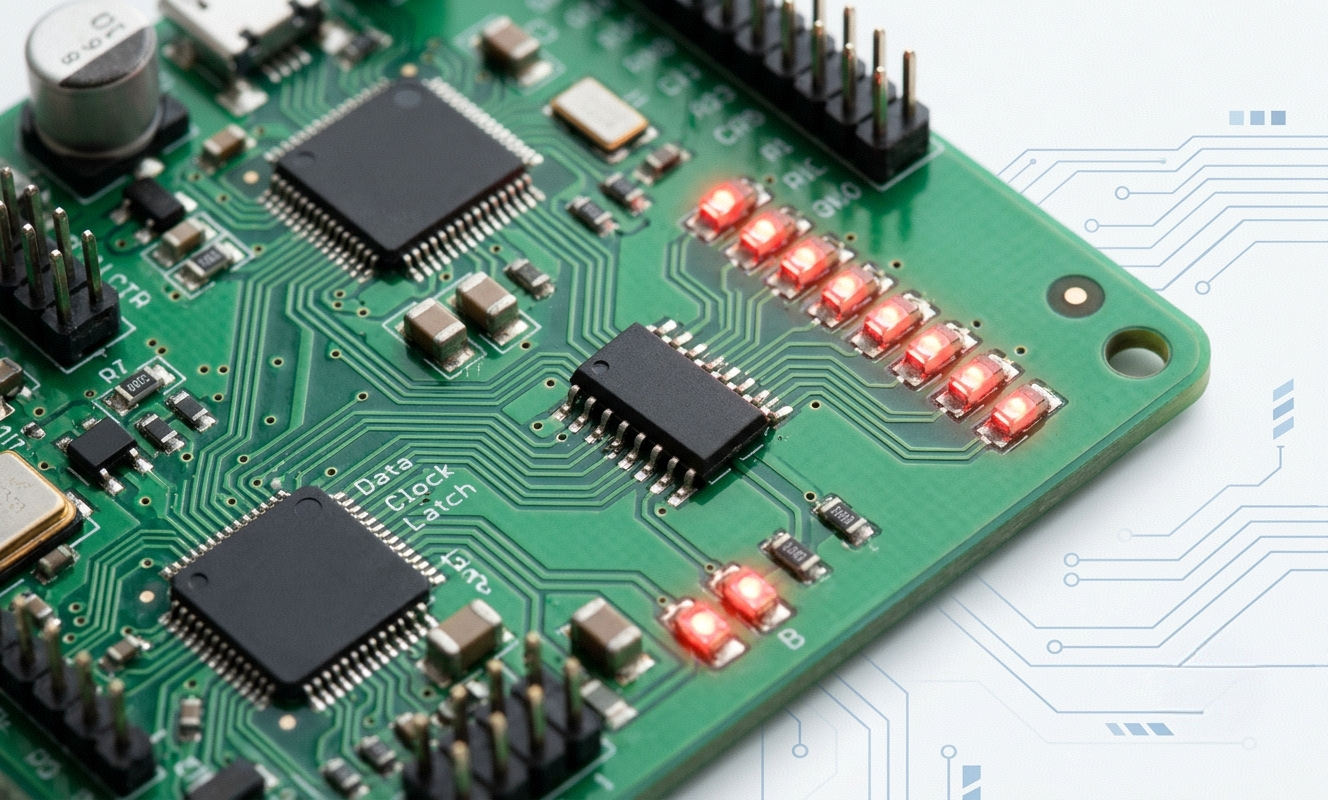
Are SN74HC595D, 74HC595PW, and MC74HC595ADR2G Direct Replacements?
Usually, they can be alternatives, but the replacement should not be based only on the part number.
The first thing to check is the package.
For example:
-
TI SN74HC595D→ SOIC-16
-
Nexperia 74HC595PW→ TSSOP-16
-
ON Semiconductor MC74HC595ADR2G→ SOIC-16
In real replacement projects, I have seen engineers check electrical parameters first and discover later that the package does not fit the existing PCB.
For prototype testing, a package difference may be easy to handle. For a production PCB, it can increase assembly cost and require a new layout.
TI SN74HC595D: A Common Reference Choice
The TI SN74HC595D is one of the most widely recognized versions of the 74HC595 family.
Many engineers choose TI parts as the reference design because the documentation is clear and the electrical specifications are easy to verify.
Key advantages include:
-
Detailed datasheet information
-
Stable product documentation
-
Strong long-term support
For industrial equipment or products expected to remain in production for years, these factors are valuable.
However, the SN74HC595D is not automatically the best choice for every application.
If a board only drives simple indicators or low-current displays, the practical difference between manufacturers may be very small.
The more important question is whether the device matches the actual circuit requirements.
Nexperia 74HC595PW: A Useful Second-Source Option
The Nexperia 74HC595PW is another common choice for logic applications.
Nexperia has a strong portfolio of standard logic products, and its devices are often considered when manufacturers want additional supply options.
Why does this matter?
Because production problems are not always caused by circuit design. Component availability can also affect manufacturing schedules.
A second-source device can help reduce risks caused by:
-
Longer lead times
-
Supply shortages
-
Manufacturer changes
When using the Nexperia 74HC595PW as an alternative, designers should verify:
-
Package type
-
Voltage range
-
Timing requirements
-
Output loading conditions
A replacement is not only about finding a similar part. It is about ensuring the new device fits the complete design.
ON Semiconductor MC74HC595ADR2G: A Practical Production Option
The ON Semiconductor MC74HC595ADR2G is another widely used 74HC595 device.
It provides the same basic functions:
-
8-bit serial input
-
Parallel output control
-
CMOS low-power operation
For companies already using ON Semiconductor components, this part can simplify supplier management.
When comparing it with TI SN74HC595D or Nexperia 74HC595PW, important factors include:
-
Package compatibility
-
Propagation delay
-
Output characteristics
-
Supply availability
For simple LED indication circuits, timing differences are usually not a major concern. However, applications using multiple cascaded shift registers should review timing parameters carefully.
Does Higher Output Current Mean Better LED Driving?
This is a common misunderstanding.
The 74HC595 can control eight outputs, but it is not a dedicated LED driver.
Actual performance depends on:
-
Output current per channel
-
Number of active outputs
-
Package thermal limits
-
PCB heat dissipation
For small indicator LEDs and low-current displays, the 74HC595 works well.
For high-brightness LEDs or large display panels, a better approach is usually adding:
-
Transistor drivers
-
MOSFET stages
-
Dedicated LED driver ICs
Selecting the correct driver architecture is often more important than choosing between different 74HC595 manufacturers.
How Should Engineers Choose a 74HC595 Replacement?
There is no single device that fits every design.
For new industrial projects, the TI SN74HC595D is often a good starting point because of its documentation and support.
For second-source planning, the Nexperia 74HC595PW provides another established option.
For existing production designs, the ON Semiconductor MC74HC595ADR2G can be suitable when the package and electrical requirements match.
When selecting a 74HC595 equivalent or SN74HC595D alternative, hardware teams should check more than the name:
-
Exact package
-
Supply voltage
-
Timing margin
-
Output requirements
-
Production availability
The 74HC595 is a simple logic device, but choosing the right version can still affect manufacturing stability. A successful replacement is not the cheapest part available; it is the part that fits the circuit, PCB design, and long-term production plan.